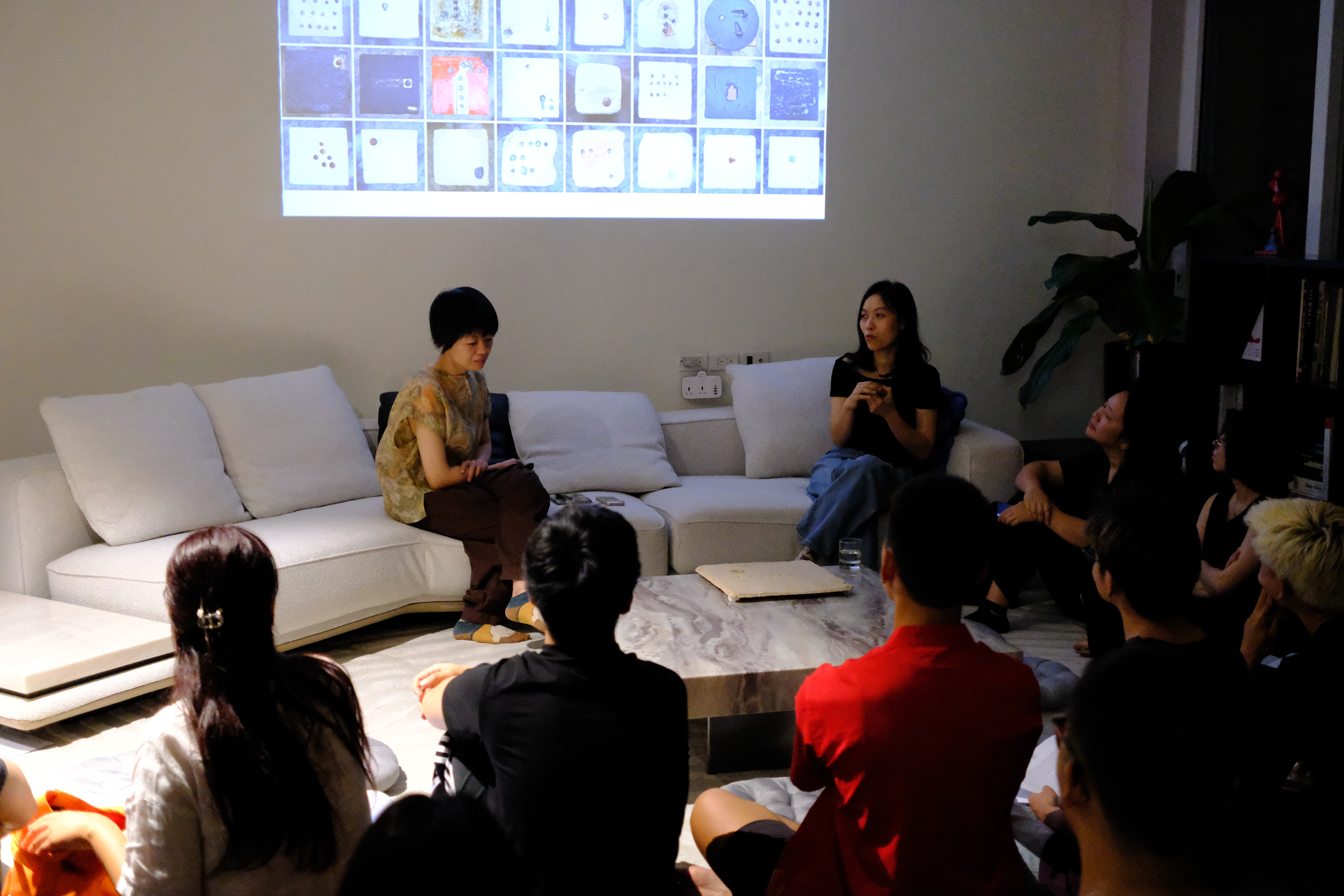
This conversation between Lâm Na and Nguyễn Tú Hằng took place within the framework of a collaborative residency program between the Artist-in-Residence Vietnam Network (AiRViNe) and Vietnam Art Collection (VAC). Most of the content was recorded during the public artist talk “The Way Home of the First Creature,” held on June 27, 2025 at VAC Hanoi, and subsequently expanded through in-person exchanges at the artist’s home in Vinh.
Unlike interviews focused on products or residency outcomes, this conversation traces its way back to origins: childhood memories with fragments of ancient ceramics, a father who spent fifty years collecting artifacts, the moment of encountering a prehistoric person preserved in stone, a first handful of clay at Bát Tràng, and the strange instant when a four-thousand-year-old object melted in the kiln. From there, the interview opens onto larger questions: what is heritage when it no longer lives behind glass? Where can the traces of an ancient human meet the traces of an artist today? And why is the open studio titled “It’s Been Many Years Since We Last Met”?
Lâm Na doesn’t speak much in theory. She speaks of earth, of marks, of her father, of a dream. But it is precisely through these very concrete fragments of memory that a strange and coherent artistic practice gradually comes into view — the practice of someone who wants to leave her own mark, place it beside the mark of someone from thousands of years ago, and see what they might say to each other.

Photo: Lâm Na’s Open Studio “It’s Been Many Years Since We Last Met”, as part of AiRViNe #03 x Vietnam Art Collection
AiRViNe: Could you tell us about the journey that brought you to terracotta? We understand you came to this material relatively late.
Lâm Na: It’s like a river flowing — one continuation leads to the next and I can’t stop. Before, my artistic practice was very different — truly very different. Then recently, almost everything began to flow.
In 2022 I was invited to take part in a workshop related to a project called “Traces.” I decided I would not repeat what was familiar. I remembered an old friend who used to sit tapping his pen against the desk — the sound of it haunted me for years. He sat in a very large, dark room — this was when I was studying in Thailand. After returning to Vinh, that image came back unexpectedly. I started pressing my fingers onto paper, just small formats at first. But when I did this workshop, the memory came rushing back and urged me to create something that moved through the space of the room.
Those fingerprints had first appeared about ten years earlier. Working with them again, they became something very powerful for me. From that point, “mark” — what remains, what is preserved in each moment — became an important keyword in my practice. And since then, all my terracotta works have followed that spirit.
AiRViNe: So when did you first hold a lump of clay?
Lâm Na: It was during a workshop in Bát Tràng. Uncle Đức from Nhà Sàn had invited everyone in the workshop to go make ceramics. I thought it sounded interesting so I agreed. Many of the other artists were from out of town and couldn’t make it, so in the end it was just the two of us — we still decided to go. I called Uncle Đức and said: “We’re still going, we don’t want to lose the momentum.” And so we went to Bát Tràng.
That was the first time I ever held a lump of clay. There were also workshops there by older artists making figures and ceramics. I had no ceramic skills at all — I could only sense the material. Holding the fresh clay, I suddenly remembered the old ceramic fragments at home, things I had lived alongside since childhood. The truth is I had wanted to work with them for a long time but hadn’t found the “point of contact.”
At that moment I thought: new clay and old ceramic, new and old — they could meet here. The phrase “soft collision” flashed into my mind. Later, “soft collision” became the throughline running all the way to now — I’ve been following that current.
AiRViNe: “Soft collision” is the meeting of new clay and old ceramic — but more specifically, which objects do you use? And why prehistoric ones in particular?
Lâm Na: I use stone axes, ceramic shards, artifacts from the Phùng Nguyên, Hoabinhian, Sa Huỳnh cultures — things from prehistoric times, four thousand, even ten thousand years old. Prehistoric objects carry within them the shared memory of humankind, of people in general.
So I only asked my father for prehistoric things. He collects across all periods — porcelain, ceramics of all kinds — but what affected me most powerfully was always the prehistoric and earthen objects. Old earth combined with new earth. When I first started, I simply thought: “Oh, I can use this to make marks on clay.”
AiRViNe: You said “use this to make marks” — but before that you were using your own hands, fingers, fingerprints. How did that shift happen?
Lâm Na: From the moment I brought my father’s objects home, I stopped making marks with my own hands and started using ancient tools — stone axes, ceramic shards, prehistoric artifacts — to create the marks instead. I thought: my mark is also someone else’s mark, the mark of some prehistoric person — so it would carry a different kind of power and open up a dialogue between old and new.
I observed the ancient objects and noticed that people from those times often repeated motifs: round dots, parallel lines, even handprints and fingernail impressions pressed into fired clay. Perhaps they were simply counting time, or decorating by instinct. For example, they ate fish, saw the shape of fish bones, found them beautiful, and drew them right then — very natural.
I think my current practice also wants to return to that simplicity: not drawing, not sketching, not depending on shape or composition — just placing myself in the state of an ancient person and leaving my “mark.” And then I ask myself: this is the mark of someone from four thousand years ago, but what is my mark? What is each of our marks? In each moment of living, what mark am I leaving? It is this thought — about “marks” and continuation — that drives me to work so much, not any ambition to have a show or an exhibition.

Photo: Lâm Na’s father – Artefact collector Nguyễn Quyết Thắng
AiRViNe: There must still be many people who wonder: why use ancient artifacts — things that arguably belong behind glass in a museum — in artworks? How do you respond to that?
Lâm Na: (Laughs.) I still remember when Hằng was once surprised and asked something like “why are you “’hrowing’your antiques into the kiln,” and I was startled and had to say “why on earth would you use the word ‘throwing’?” In Hằng’s imagination these things should only be in a museum, and using them in artworks sounded carelessly disrespectful toward the objects. But that’s not it at all.
My family treasures these things deeply. My father keeps them in a cabinet, treats them with great care — it’s nothing like casually throwing them in a furnace. When Hằng came to the house she could see how I arrange everything, and she understood immediately that each object is cherished. When I began using these old things, it was genuinely the material itself that called to me. I chose earth as a “hard drive” in which to store traces; it moves through time, it outlasts me. First: earth. Second: prehistoric objects.
And I have a very strong impression from when I was small: I once encountered an actual ancient human being, in flesh and bone. They were lying in a block, surrounded by their possessions and jewelry. I wasn’t frightened — I truly wasn’t. For the first time I saw clearly: ah, so this is what is inside the skin and bones of a person. From that moment, something was set in motion within me. It wasn’t until ten years later, when I “met earth,” that I made the connection.
AiRViNe: Could you tell us about the first time you put an artifact into the kiln?
Lâm Na: Immediately after the idea came to me, I went back to Vinh to collect the old ceramic pieces from home, then began a period of continuous work. The result was several hundred terracotta works from that journey.
At first I still hadn’t thought about firing them. But then I put them in the kiln anyway. Some went straight in without much thought. When they came out I was overwhelmed — because there are so many states of matter: some things only reveal their true nature through fire, some hold their shape, some melt away. One melted because it contained metal — it ran out as a black smear.
I thought immediately: “My god, four thousand years melting out? How can four thousand years possibly melt out?” The feeling was overwhelming, extraordinarily powerful. If I had never touched it, it would have stayed buried forever, unknown to anyone. Suddenly, from just one act — a single idea, a very small human gesture — it transformed: put it in the kiln, and four thousand years poured out, or vanished, or evaporated.
So no one can know in advance. These marks — those very black smears — how were they made? The mark remains, but the thing itself is gone. Some kept their shape, some lost it, every kind. These things truly lodged something deep in me — like waking up to so much at once.
It reminds us of a cycle, some recurring circuit — a cycle that always exists. As though people are endlessly swept up in the whirlpool of their own lives without ever thinking about something more common to all of us.

Photo: Public artist talk “The Way Home of the First Creature” with Lâm Na and Nguyễn Tú Hằng, held on June 27, 2025 at VAC Hanoi.
AiRViNe: When you interact with an artifact, do you feel as though you are collaborating with the person who made it?
Lâm Na: Yes, because I won’t think of it only as an antique. I think about history, but at the same time I sense it as a witness. It carries the feeling of a human being inside it.
When I interact with it, I feel as though I am speaking with someone who lived very, very long ago. They and I — both using those same objects. The material itself already has depth, already holds so many layers of its own meaning. I only need to bring it here, place it inside a new “living being,” and on its own it will have the space, the chance, to speak its own story.
Even my own words sometimes become meaningless beside it. As I’ve said before, “things of yesterday have already passed, and tomorrow hasn’t come yet.” But things that have existed for thousands of years — how can I put them into words? That’s why I think visual art and contemporary art are a kind of medium — a form that goes beyond language. It lets heritage move in its own way, through contemporary art.
AiRViNe: “Heritage in motion” — could you say more? How do you see the role of contemporary art in relation to heritage?
Lâm Na: I think when heritage is given a space of emotion and thought by contemporary art, it prompts us to ask more questions. I want viewers not only to look at these objects through a historical or archaeological lens, but to place them within an ongoing unfolding. To let them be in friction with the present — not simply lying still behind glass, but continuing to move and to continue.
That, I think, is the role of contemporary art: to demonstrate that heritage can still be alive, can still be felt in the present.
AiRViNe: The way you title your works is also fascinating — “The First Creature,” “The First Land,” “Once – Continuing”… They evoke something vast and ancient. Why these names?
Lâm Na: All my works — whenever I place these objects into a new ground — I give them names like “the first creature,” “the first land,” or “once, continuing.” Because I want viewers not only to see the objects through history or archaeology, but to place them within an ongoing movement. To let them be in friction with the present, not simply lying still behind glass. “The first creature” — it is a beginning, it is something new. It carries the feeling of rebirth, of starting again from the beginning, like a cycle of return.
AiRViNe: And the open studio at VAC: “It’s Been Many Years Since We Last Met”?
Lâm Na: That one has a very particular story. And it’s also a little funny.
Looking at these objects I see such strong impressions of prehistoric human presence — thousands of years. I was even joking recently that I might need to move to a new “level” — millions of years. This time I’m working with fossilized wood, and fossils go back hundreds of millions of years. Hundreds of millions of years is almost beyond imagination.
By chance, I also came to have a collection of beetles — and they too are fossils. The tree and the beetles: perhaps once that entire forest existed and now only these two things remain. Perhaps that beetle once lived inside that very tree. And suddenly they meet here — a contact that could only happen once in thousands of years.
But the real origin of the title is a dream my father had — several years ago now. Usually my father dreams but wakes up remembering nothing. This particular dream he kept remembering, and wrote it down in a notebook because it kept recurring.
In his youth, my father’s family home was in the countryside of Nam Đàn, near Ho Chi Minh’s birthplace. But from young adulthood he had moved to the city of Vinh. He always remembered the old house in the village. In the dream, he saw himself going out to the garden at the family home and digging up a stone. When he lifted it, my mother called from inside the house: “That’s dirty, full of moss and things, wash it off.” When he brought it in and washed it, a line of text appeared: It’s been many years since we last met.
My father also works with antiques and has long read classical Chinese script, so he recognized it as Hán characters. He would tell us this dream from long ago and occasionally bring it up again. Later, when I was thinking about working with fossilized wood and all those letters — letters spanning millions of years — I remembered that phrase. And so I gave the work the title: It’s Been Many Years Since We Last Met.
The feeling is of something very long ago, but also possibly just recently. A feeling like sudden joy — “oh, we’ve found each other again!” — and perhaps it can stir something in viewers that makes them feel close.

Photo: Lâm Na’s Open Studio “It’s Been Many Years Since We Last Met”, as part of AiRViNe #03 x Vietnam Art Collection
AiRViNe: It seems as though Lâm Na has been in contact with earth her whole life without fully realizing it. Do you feel that way?
Lâm Na: Yes, actually I do recognize it. Because sometimes I write something and then forget about it, but Facebook will remind me — “ten years ago you wrote about the primordial” — and I realize: ah, it seems I have been touching this for a long time already.
AiRViNe: You grew up in a family where your father has been collecting antiques for fifty years. Looking back, how did that shape you?
Lâm Na: I grew up in that environment in a completely natural way. My father didn’t only collect: he grouped and classified, made wooden stands, displayed everything like a miniature museum. Even a small piece of ore, only five or seven centimeters, would have its own stand. He maintained that attention for fifty years.
And he didn’t only collect beautiful things. He understood each artifact in his own way. He told me as early as primary school that Darwin’s theory of evolution was wrong, because the artifacts he’d found showed that apes couldn’t possibly have evolved into humans — he said it very naturally, like someone speaking from direct lived experience rather than theory. Or he would talk about old coins. Normally, people who excavate artifacts keep coins in jars and break the jar to sell the coins. But my father was one of the first to say: “Stop breaking the jars. Sell the jar intact.” Because the jar itself expressed social standing — a poor family had a small jar, a wealthy family had a large one. The jar, therefore, was also important.
That environment created a very different relationship with objects than most people have. Growing up, I didn’t see antiques as sacred untouchable things — I lived among them. That attitude, I think, explains why I can put them in a kiln without any sense of contradiction.
AiRViNe: Did your father grieve, seeing his collected objects used in your artworks?
Lâm Na: He said at first he did feel the loss, but then he thought about the theory of matter. He explained that if you consider matter as only the transformation of the shape, size, or state of the molecules and atoms within an object, then the way I preserve and transform antiques is also a very interesting form of conservation — in its own way.
I think so too. Earth already suggests the primordial in itself. Earth is the first material — before everything else existed, earth was the beginning. And when we disappear, perhaps earth will be the last thing to remain. The marks of things persist, but the things themselves are gone — and where they go from there, no one can know.
AiRViNe: Looking back across the journey from fingerprints on a wall to terracotta, to prehistoric artefacts, to fossilized wood — where do you feel you are headed?
Lâm Na: I feel I am expanding the frame of time. If it began at four thousand years, it is now hundreds of millions of years with fossils. The frame keeps widening.
But what matters more to me is the continuation itself. “Once – Continuing”: I want to make works that are still living across millions, thousands of years.

Photo: Lâm Na’s Open Studio “It’s Been Many Years Since We Last Met”, as part of AiRViNe #03 x Vietnam Art Collection
Overview
Lâm Na does not identify herself as someone who works with heritage, even though her works compel viewers to revisit fundamental questions about conservation, value, and the meaning of an object when placed in a new context. For her, everything begins with “mark” — and continuation. Not restoration or preservation, but carrying forward: placing her own mark beside the mark of someone from thousands of years ago, and letting fire decide what remains.
What is notable is that this practice did not emerge from academic research but from a specific living environment: a house in Vinh with cabinets full of the father’s collected objects, childhood stories about the Phùng Nguyên culture, a dream about a stone inscribed with characters. Lâm Na’s work, in that sense, is the sediment of all of this — not the result of a purely artistic intention formed in advance.
And perhaps that is why, standing before her terracotta works, viewers can feel simultaneously familiar and strange — as if encountering something they have always known but never quite seen clearly.
Interviewer: Nguyễn Tú Hằng
Editor: AiRViNe
About the artist:
Lâm Na was born in 1987 in Vinh. She graduated from Huế University of Fine Arts in 2011 and Mahasarakham University (Thailand) in 2014. Her practice spans many materials, but she truly began focusing on terracotta in 2022. For Lâm Na, “earth seems to maintain a state of silence, quietly receiving everything and ceaselessly transforming.” Earth bravely takes in even the most violent things with gentleness, and in doing so moves her with its own profound courage.
Alongside her debut solo exhibition Once – Continuing (2023) at Hanoi Studio Gallery, Lâm Na actively participates in group exhibitions and art projects, including The Grapevine Selection organized by Hanoi Grapevine in 2015 and 2024.
During her residency at VAC as part of AiRViNe #03 x Vietnam Art Collection, Lâm Na continues to explore dialogue across temporal fractures, between present and past practice, constructing a new discourse on the individual timeline as a witness to humanity. The open studio program It’s Been Many Years Since We Last Met took place at VAC Hanoi in June 2025.

Photo: AiRViNe team with Lâm Na and her father at her house in Vinh.
Leave a Reply