Field notes from Pa Rang Cafe Art & Stay
and Studio88 Artist Residency, Chiang Mai
Nguyễn Tú Hằng & Trần Thảo Miên
May 2026
Introduction
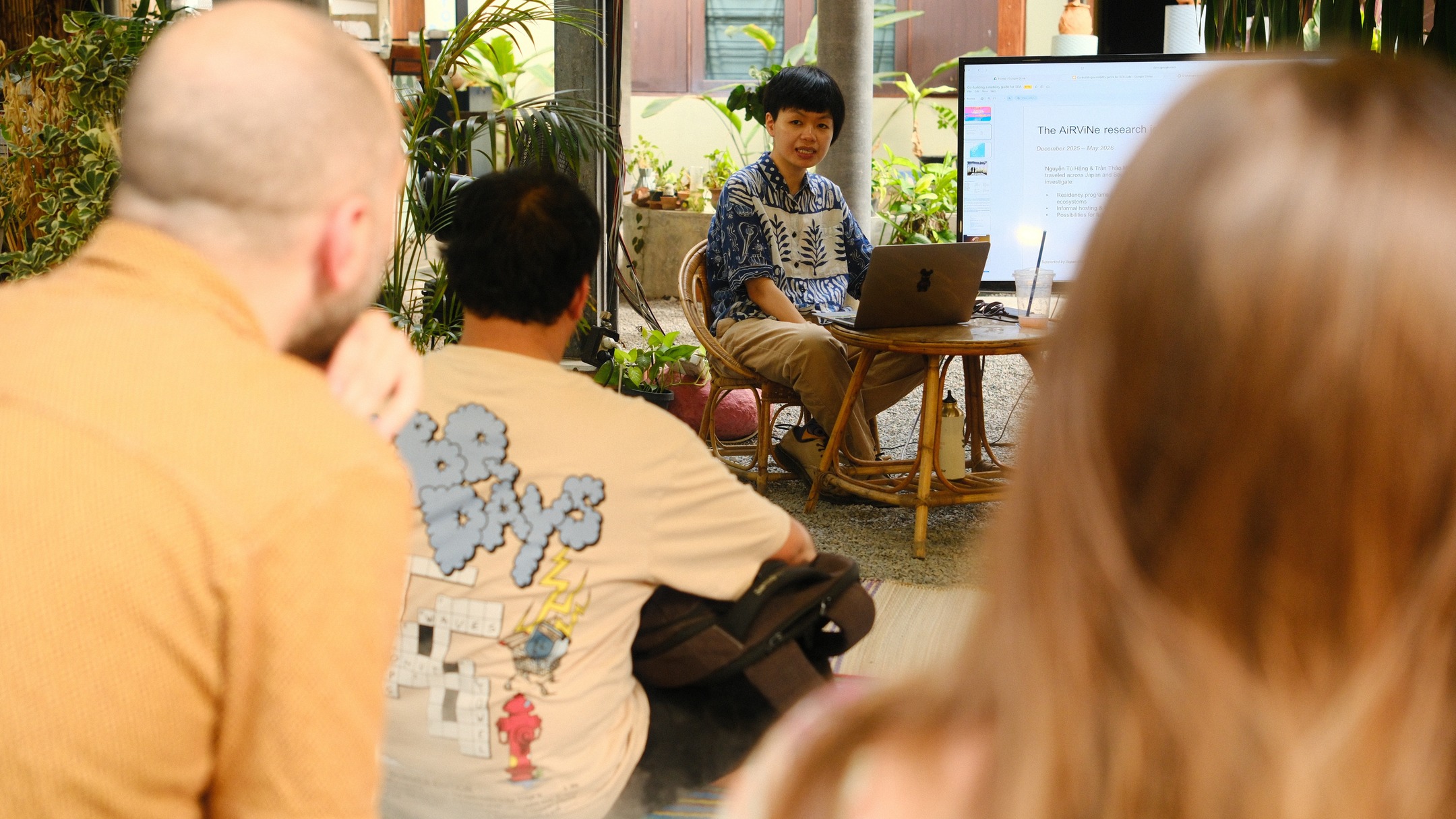
Over the first week of May 2026, we held two public sessions in Chiang Mai, four days apart. On May 1, we convened Co-building a Mobility Guide for Southeast Asia, an intimate discussion and working session, moderated by nguyen.transitory and co-hosted with Pa Rang Cafe Art & Stay. On May 5, at Studio88 Artist Residency, we held Navigating the Artist-in-Residence Landscape in Southeast Asia, a more practical field-guide session drawing on our fieldwork across the region.
Both sessions grew out of the same six months of research: traveling across Japan and Southeast Asia under the Japan Foundation Asia Cultural Exchange Fellowship, visiting residency spaces, artist-run organizations, and the individuals who hold these ecosystems together. That research began in Japan, documented in I have a question: a review of AiR ecosystems in Japan, where we examined a system built on state-led cultural policy now undergoing structural transition. In Southeast Asia, the starting point is different. There was never a centralized system to begin with. What exists instead is something more organic, more relational, and far harder to map.
The two sessions addressed this from different angles. We raised the broader question: how do cultural practitioners move within and across Southeast Asia, and what infrastructure, visible or invisible, supports that movement? in the first session, while in the second one we asked a narrower, more practical question: how does an artist navigate the residency landscape specifically: find spaces, fund a stay, prepare, and understand what happens to a program once they show up? This article draws both conversations together.
A Landscape Without a Map
If you try to look for the AIR landscape in Southeast Asia directly, you might not find much. There is no single place you can point to and say “this is it.” No equivalent of AIR_J, the Japanese database that catalogues over 200 programs. No regional funding body. The most widely used mobility resources: On The Move, ASEF culture360,… are valuable, but they carry assumptions that do not always hold here. They take an outbound approach, built to move practitioners from the Global South to the Global North rather than within the region. They are inter-regional rather than intra-regional, useful if you want to go from Hanoi to Berlin, less so from Hanoi to Manila. And the funding they point to is built around competitive proposals, with acceptance rates of two to five percent. Mobility under this model functions as a lottery, not infrastructure.
But if you start moving through a city a bit differently, not through institutional channels, but through the recommendations of friends and acquaintances, patterns begin to show up. You hear about a space from someone. You follow it. You meet people there who point you somewhere else. Eventually, you become part of the pattern.
What we found across seven countries (Philippines, Malaysia, Indonesia, Timor Leste, Thailand, Laos and Cambodia) is a landscape that is organic, grown from communities rather than designed top-down; experimental, where formats change and rules stay loose; and community-driven, run by artists and collectives rather than institutions. It exists on a spectrum of visibility. On one end are fully-built programs — a website, an open call, an application process, a listing on ResArtis or TransArtists. These exist in Southeast Asia, but they are not the whole picture. On the other end are programs you cannot easily find: no website, or only a social media page; you hear about them through someone; they exist as invitations rather than applications; they shift shape depending on who is there. This is a large part of the region’s landscape, and any mapping that ignores it is describing a different place. The practical implication is simple: you do not need the full picture to begin. Just move through it.
The Mobility Paradox
At Pa Rang, we posed a question to the room that anchored the whole session: is cultural mobility only for those who have the privilege to move?
The existing frameworks assume resources that many practitioners in the region do not have: English proficiency sufficient for competitive proposals, institutional affiliation, time to apply, a portfolio website, and visa privilege, which is far from equally distributed across Southeast Asian passports. These function as invisible gates. There is also an outbound bias: most programs are designed to send people out, not to receive or host them. Who builds the landing pad? That labor — hosting, translating, connecting — is almost never funded or recognized. We called this the invisibility of care. The people who make mobility possible are never in the budget. They are the infrastructure, but they remain invisible.
Before turning to how people move, we paused to ask why they move at all. The answers are various: cultural exchange, learning, research, introducing new work to a different audience, concentration, observation, or simply rest. Not every stay needs to produce an outcome. And the practical requirements for moving are simpler than grant systems suggest: transportation, accommodation (a residency, but just as often a hotel or a friend’s house), a per diem, and enough local context to be useful rather than extractive. We also raised conditions that mobility frameworks rarely address: artists with children face entirely different logistics, and in a region where most residencies are self-funded, how artists sustain themselves during and between stays is not a peripheral concern. It is central.
The Invisible Infrastructure
When we turned to what mobility actually looks like within Southeast Asia, a different picture emerged — not a system, but a network of uncertainties held together by relationships. This infrastructure is built on friendship: friend-of-friend hosting, WhatsApp groups, informal introductions, shared meals that turn into collaborations. This is not a gap in the system. It is the system.
Within this network there is a particular currency: the vouch. Personal recommendations open doors that applications cannot. Trust builds through repeated encounters at events and festivals through showing up again and again until you are known. And there are people we began to call knowledge holders: those who do not move but hold local context: translators, fixers, guides, the ones who say, “When you arrive, call this person.” They are essential to the ecosystem, yet almost never recognized as part of its infrastructure.
This same observation carried into the practical question of finding one’s people. We talked about what it takes to build a network that opens doors. It starts with showing up — attending gatherings, even small ones; appearing at open studios and talks; introducing yourself honestly. It continues with being useful before you need something, since reputation, not application, is often the real currency. And it depends on keeping the thread afterward: staying in touch once a residency ends, sharing opportunities, becoming a connector rather than just a contact.
What the Region Offers
It would be easy to frame all of this as deficit: an absence of institutional support, a lack of centralized systems. That framing would be wrong. Southeast Asia has real advantages rarely acknowledged in global mobility discourse. Lower costs of production, living, and travel make experimentation possible without large grants. The region’s proximity — Bangkok to Hanoi is a two-hour flight — makes short visits and weekend residencies feasible in ways unthinkable between, say, Berlin and São Paulo. There are shared contexts: overlapping histories and challenges, a mutual understanding that does not always require the cultural translation that North–South exchange demands. There is informal flexibility — artist-run spaces, cafés as venues, homes as residencies — meaning less bureaucracy and more possibility. There is a warmth factor: generosity and hospitality functioning as cultural infrastructure. And there is the advantage of emerging together: building systems from scratch means the region can design them well, rather than inheriting broken models from elsewhere.
This flexibility, though, has a structural consequence worth taking seriously. Because most Southeast Asian residencies are self-funded or partially funded — the artist paying for their own stay, and sometimes studio access or production support — residencies respond directly to demand. Fully-funded programs exist, but they are rare, usually tied to international partnerships or specific grants. This creates a feedback loop: if artists primarily seek easy, retreat-style stays, more retreat-style residencies will emerge, making it harder for the next artist who needs a genuinely production-oriented program, or room to fail and experiment. Artists do not just participate in this ecosystem. They shape it. The kind of practice an artist brings determines the kind of residency a space becomes — for that artist and for everyone who follows. Think twice when you apply: what can you contribute, and what can the residency actually do for you?
Designing an Entry Point
Because institutional support is uncertain, the artist has to lead. At Studio88, we proposed a three-step approach for doing so deliberately rather than by accident. First, start with a project that resonates with the destination — an idea connected to the place you are going, not simply your existing project relocated somewhere else. Second, go back to your own roots for support: your embassy, local cultural partners who may have worked with that city or residency before, local funders, or cultural institutes — all of which run programs that can support mobility even when not explicitly labeled as residency grants. Third, only then reach out to the residency itself. Arriving with a resonant project and some backing changes the dynamic: you are not simply applying, you are proposing a collaboration.
Where do you look for funding when the major grants are not an option? Mobility-specific resources like On the Move, ASEF culture360, and the Asian Cultural Council offer regional guides worth knowing. Arts councils often run smaller grants that are less competitive than international headline programs, and cultural institutes — the British Council, Goethe-Institut, Institut Francais, Japan Foundation — run funding that is sometimes overlooked. Beyond the usual channels: private foundations with cultural programs, university travel scholarships, foreign affairs departments running country-focused cultural years, and funds such as the Prince Claus Fund and ifa’s Artists’ Contacts — alongside, often the most accessible option of all, one’s own embassy’s cultural program.
The Practical Toolkit
We closed the second session with concrete preparation. On the papers side: a portfolio in shareable digital formats, a bilingual CV, a project statement flexible enough to adapt to context, a working budget, and basic research on the destination. On the mental side: expect uncertainty and work with it; come with openness rather than only an agenda; treat rest as part of the work; document process, not only output; and build relationships, not just a portfolio entry.
Across seven countries, we visited or engaged with more than fifty residency spaces that we hope to be able to feature them in our platform soon. A comprehensive list of over thirty programs in Vietnam has been published separately as A guide list to artist-in-residence (AiR) in Vietnam. This list is incomplete, but it represents the core of our fieldwork.
We also shared what AiRViNe has been building as a direct outcome of this research. Each represents a different model, and together they form an experiment in building a residency network from the ground up, with limited resources and maximum flexibility.
Toward a Guide That Doesn’t Yet Exist
At Pa Rang, the session closed with a design question posed to the room: what should a mobility guide for Southeast Asia actually contain? The consensus was clear about what it should not be — not a database of competitive grants, not a directory organized by institution. What emerged instead was the idea of a practical, relationship-centered, intra-regional resource: local contact networks rather than organization directories, hosting and accommodation options beyond formal residencies, practical logistics around visas, transport, costs, and seasons, and cultural context written by local practitioners rather than external consultants. Crucially, it would need to be a living, peer-updated resource rather than a static document that goes out of date the moment it is published.
We asked the room four questions we are still processing: What do you wish you’d known before your first cross-border move in Southeast Asia? Who in your network is a connector but never gets credited or supported? What’s one resource you’d put in a SEA mobility guide that doesn’t exist yet? And, simply, what can you offer, and what do you need?
Taken together, the two sessions addressed different scales of the same question. The first asked how practitioners move within Southeast Asia and what infrastructure — visible or invisible — supports that movement. The second one asked how artists specifically navigate the residency landscape: how they find spaces, fund themselves, prepare, and shape an ecosystem through their own participation. What connects both is a conviction that the knowledge needed to navigate this region already exists. It is held by practitioners, by knowledge holders, by the people who run spaces and the people who connect them. The challenge is not generating new knowledge but finding ways to share what is already known — practically, accessibly, and in a form that can be updated as the landscape continues to shift.
Our research trip concludes at the end of May 2026, after which we return to Hanoi with plans for a comprehensive mapping of AIR programs across Southeast Asia, a parallel mapping of European and East Asian programs that support Southeast Asian practitioners moving in the other direction, and the continued development of AiRViNe’s pilot programs. We hope these two sessions mark the beginning of a longer conversation — and that the guide, when it comes, will be co-built by the many people who showed up, shared what they knew, and asked the right questions.

Photo (and above): The session at Pa Rang Cafe & Stay. Image courtesy of @sou.initiative.
The May 1 session was put together by SOU Initiative and AiRViNe with the support of Pa Rang Cafe & Art Stay, tomorrow.lab, International Hackteria Society, and Arai Eek, within the scheme of Co-Laboratories: Technobiological Futures, funded by Pro Helveltia.
The May 5 session was hosted by Studio88 Artist Residency.
Our research stay in Thailand are fully supported by S.A.C Gallery & Light Bulb Residency (Thank you so much, Joy!) .
Our research is supported by the Japan Foundation Asia Cultural Exchange Fellowship (Visual Arts).
Leave a Reply