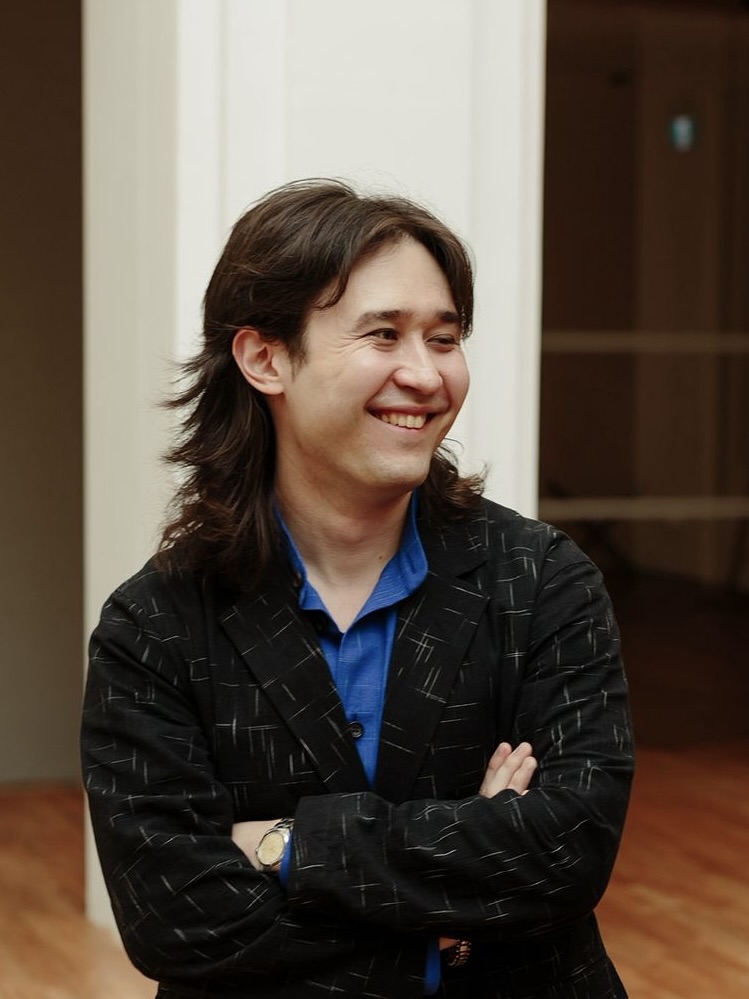

Hunter P Deerfield: On the KIRTI Project
Interview with Neutral Colors
Vietnamese translation by Lê Vân (Ran)
This interview opens up an in-depth conversation with Hunter P. Deerfield—the founder of the KIRTI project—about his journey in constructing a decentralized “anti-archive” for Southeast Asian contemporary art. Born into a family with a rich archiving heritage in the US and trained in art theory in Singapore, Hunter chose an unconventional path: abandoning traditional publishing structures that are often expensive and susceptible to censorship, in favor of a samizdat spirit (ad-hoc, DIY self-publishing) using regular A4 paper and local copy shops. From his vantage point as an outsider, Hunter candidly shares his experiences of full-time travel, building trust through face-to-face studio visits, and navigating complex issues around the “politics of representation” amid a fracturing global landscape. Ultimately, the KIRTI project emerges not just as a tool for oral history, but as a survival strategy and an intuitive “flow-state” meant to map and make sense of the raw, emergent art scenes across the region.
Neutral Colors (NC): The format of your booklet is very free — there are interviews you’ve conducted, but also excerpts from previously published texts.
Hunter P Deerfield (HPD): The idea was to have a container that could hold multiplicity, from conversations, archival documents, images from studio visits, artists’ process, and even anthologized or excerpted texts.
My original inspiration was the Surrealist journals of the 1920s-30s — Andre Breton’s Minotaure, George Bataille’s Documents — which interspersed artists of their time with photographers, anthropologists, psychoanalysts, even archaeologists… I was interested in creating a space that had a similarly wide-ranging, interdisciplinary, experimental nature. The goal was to express the energy and landscape of this time and place — basically to show that a lot was going on, artistically, in a region that many knew very little about.
NC: What first inspired you to start this project?
HPD: I graduated from college in 2018. I was studying in Singapore and had written my thesis on archival theory in contemporary art. A month before graduating, I visited Ho Chi Minh City and was introduced to several artists. I was impressed by their friendliness and willingness to introduce me to their peers — it was a small, close-knit scene — but also as I spent time with them, I kept hearing the same issues reiterated: there was no money, there were very few institutions, there was censorship… and the few artists who got shown internationally were those who spoke English fluently, were educated overseas, generally came from wealthy families, and knew how to play a certain curatorial or self-promotional game. But many other artists did exist.
One just had to be in the country to find them, and then it was easy to meet because everyone knew each other.
Also, there weren’t many archives or publications showing contemporary art from the region that I could find. And the few that did exist were quite academic or institutional — Southeast of Now, Asia Art Archive, etc. — or very cursory, narrow, or out of date. I was interested in something more conversational and free-spirited. And I thought, if I set out, working via introductions, meeting the friends of those I already knew, I could probably meet a lot of people quickly.
So I started traveling full-time, living out of a carry-on suitcase and meeting as many artists as I could, first in Vietnam, then Cambodia, Thailand, Myanmar, then back to Vietnam, back to Thailand, etc. And I started doing interviews — often with friends or friends of friends, aiding as translators if needed — and I started taking images of artworks and studios… and so this informal archive started to coalesce.
NC: How do you feel about the project now, as you continue working on it?
HPD: The project has gone through several phases already. The first phase was from its inception, the fall of 2018, to the beginning of Covid, early 2020, about a year and a half. There was high energy, high momentum. I was traveling full-time, having four, five, six meetings a day, almost every day. Covid cut this short, and during Covid (the second phase) I was living in Hanoi under lockdown (for the first year; the second year I returned to the US) and I wasn’t able to do much traveling or meet many people, but I did have the time and space to clarify aspects of the project, and that’s when I developed the DIY, ad-hoc samizdat format — using A4 paper, local printers, etc. The third phase: Covid restrictions lifted in Vietnam during the spring of 2022, and I returned to re-establish the project and reacquaint myself with the region, or so I hoped — in fact, I got sidetracked and ended up moving to London by the end of 2022, where I lived for about two years… which is another story, but in October of last year (2024), I moved back to Vietnam, to Ho Chi Minh City, and I’ve been working on the project full-time again, which might be considered its fourth phase.
So already it feels like quite a while, but with periods of focus and lassitude. There’s no money in it — though I’m very fortunate to be able to work for my parents’ business remotely, which helps fund my travels — and there are interests and passions and relationships pulling me in other directions… also the project’s scope is sort-of impossibly large and expansive — art, archiving, Southeast Asia, now widening to East Asia — so there’s a hopelessness in many ways as I look for ways to sustain a project which feels impossibly too big for myself to do alone. But in other ways, I feel like I’m just reaching a point of critical momentum. It’s maddening, but I have to continue, and the road will become clear — or so I tell myself.

NC: When did you first become aware of the act of archiving? What was that experience like?
HPD: My parents run an archive — the Mark Shaw Photographic Archive — which is the estate of my grandfather, who was a mid-century American fashion and celebrity photographer. I could say that I grew up “inside” an archive, since my parents ran the business from home, and I was home-birthed and then homeschooled and the attic (which is incidentally now my room when I come home) is where the archive was set up. So there are various suggestive coincidences or conjunctions between my family’s archive and my own upbringing.….
I didn’t think much of my parents’ business or archives at all until college, when I read the essay “An Archival Impulse” by Hal Foster. He is an art theorist who was referencing an earlier essay— “An Allegorical Impulse” — written by another art theorist, Craig Owens, who had tried to explain the then-advent postmodern trend in contemporary art. Foster, writing from the vantage of the early 2000s, was trying to position the archive conceptually as a tool in an era of postmodern diffusion — what did anything mean anymore? when everyone was doing everything all at once and in every direction? and when everything was equally susceptible to critique and deconstruction — which could perhaps act as a system of centralization or meaning-making… basically, archives were, or could be, some sort of key out of the postmodern impasse which those interested in the possibility of an avant-garde keenly felt… basically, archives were perhaps a magic formula which could bring disparate things together and unify them.
NC: Your project is freely distributed, only a few copies exist at any time, and each printing allows room for updates. Where did these ideas come from? What do they mean to you?
HPD: Initially, I was looking to publish traditionally, and I was meeting with publishers and potential funders in Southeast Asia. What I quickly learned was how much couldn’t be published, or was off-limits to discuss, in every part of the region — which of course any contemporary artist worth their salt was likely touching upon somehow, however obliquely – and so there was a lot of tension between what artists would make and what could be published.
Being outspoken and plainspoken is very important to me, and I wasn’t interested in making something censured or curtailed in any way… so it became clear I couldn’t publish in Southeast Asia. Then I looked to the West to find publishers, but I quickly learned there wasn’t a lot of money in art publishing — none, in fact — and that even if I could find a publisher, because my project is so image-heavy, any publication would be extremely expensive to produce.
I had put together a 300-page prototype, featuring fifty different artists, to show publishers, and that alone had cost me over $300 to print up. So any publication I could make would essentially be a coffee-table book, a luxury item, which didn’t sit well with my intentions for the project.
And even if I could find a publisher in the West, I couldn’t import the books back to Southeast Asia because of censorship, and even if I could import them, very few could afford to buy them.
But I realized, actually of all the people I met to share the project with — museums and curators and publishers, in the West and in Southeast Asia – those who were most excited and supportive of my project were the artists themselves. They wanted to share their work, but also they wanted to learn about the other artists I was meeting in my travels. I had thought the regional art scene was close-knit, but I realized that while certain key figures knew each other, most artists were very disconnected — across art scenes, across disciplines, across countries. Most artists were using the internet to learn about trends in contemporary art from the West, but with little sense of what was going on next door.
I didn’t want to create something that would be extractive (available overseas, when my primary audience I discovered were the artists themselves — who were so generous to support me with their time and introductions. Also, it didn’t feel right to create a publication that would be expensive and exclusive because that didn’t reflect the economic and social realities of the art scenes I was encountering in Southeast Asia, which were DIY and ad-hoc and ground-up and grassroots. I wanted the project to reflect that.
So how to do this, with no funding, with no publisher, and censorship? During Covid, I began to reframe the project, and I started getting interested in samizdat, the self-publishing practices under the USSR of producing and distributing banned materials, and that’s where the idea for the booklets — made using A4 paper, printed from local copy shops — came about.


NC: You update and reprint the editions multiple times—why do you choose paper over the web, where editing is much more flexible?
HPD: Websites disappear easily — domains expire — and are taken less seriously, I feel, too. I wanted something physical, that I could place in someone’s hand, as a gift, in exchange for their time and willingness to meet. I’m interested in collecting antiques, especially old books, so I know material objects have an afterlife; they go into the world and end up in all sorts of places across time. My project exists already scattered across the globe, from all my meetings and travels and printing and giving-away. If I stop tomorrow, a material legacy still remains.
I’m not opposed to the web per se, and in fact I’m working on rebuilding my website to act as an online archive for the project. I’m interested in how a web archive can function in a meaningful way that suits the project and plays to the strengths of what a website can do over print. But the web is much harder for me to work with, as a non-coder.
Another consideration is that some of this material is quite sensitive, and so broadcasting it too openly online, where everyone can see, is potentially dangerous. With a small print circulation — limited to one-to-one meetings and the trusted spaces that carry this publication – that risk is at least minimized.
NC: Rather than conducting online interviews, you travel to where the artists live and stay there. Why is that important to you? And why do you choose to work with local printing services?
HPD: Meeting in person is absolutely necessary. I would have no interest in this project if my only contact with artists was virtual. And meeting on their terms — where they live, where they work — is key. I want to evade somehow performance and posturing. Talking online, or meeting in an unfamiliar place for the artist, makes building a genuine human connection harder. The goal is trust. So I go to them. Also, I want to see their studios, and work in person. That’s critical.
I work only through personal introductions, and I try my hardest to meet whoever I am introduced to, regardless of where they may be. I never compile lists beforehand or research an art scene’s “important” artists to meet, it’s up to who I’m introduced to — serendipity is the guiding force of the project, as one anthropologist put it.
NC: Why is print-on-demand useful as an archival method? What ideals do you have around archiving and distribution?
HPD: I can’t bring stacks of publications into the countries I’m traveling to — I could get into trouble, and besides, I don’t have much space in my luggage — so I need to produce them wherever I am, using whatever printers I can find. I like this flexibility, and it’s important that the archives — these interviews, images, and other documents — are accessible, and visible, and put into people’s hands. Which is contrary in many ways to how archives function normally, as a reserve of information stored away or made inaccessible, or controlled, or immobile. In this regard, my project can be considered an anti-archive, in that I’m interested in creating and circulating a set of materials that is an alternative to (and often contrary to) the officially sanctioned narratives of that region.
Printing as I move also allows for me to match demand, rather than being constrained by a predetermined edition size. The cheap materials — office paper, staples, copy shop printing — prevents the project from becoming too precious. I have little regard for the self-seriousness that a lot of art world projects carry: my goal is something closer to the ground, in all its connotations.

NC: Tell us about your choices in size, format, and design—what do they represent?
HPD: Booklets are made using A4 paper, the standard paper size used in most countries globally.
They’ve been designed specifically to match the constraints of regular nonspecialized printers — e.g., 5mm margins, to accommodate printable area, with duplexing; no (or few) images across centerfolds, due to low image quality at larger printed sizes, etc. Everything is trial and error.
And there’s a wonderful simplicity, even elegance, which comes from reverse-engineering the design from what sheets of A4 paper, folded in half and stapled together, can accommodate.
The booklets have color bars on their covers because ink and paper quality varies across each country, city, shop — ink-jet vs laser, modern vs outdated machinery, etc. — and I want the booklets to underscore this point. I hand-date and note the city and country of production on each booklet, akin to an artist’s edition in a way… I also note what draft each booklet is, as I keep updating them over time. There are dozens of variations — in design, in content — already. It’s important that the booklets and their design reflect or embody this fluidity and iteration, as the project itself is growing and changing and responding to the constraints and opportunities that I’m presented with.
NC: Have you received any responses to your work? Has distribution changed anything?
HPD: I feel like I’ve lived through peak globalism. When I entered college in 2014, it was at an experimental school started by the Singaporean state in league with a US institution — Yale-NUS college — and its purportedly grand goal was to build ties between the East and West. My project, since 2018, of roving around meeting artists and trying to share conversations across borders is arguably in a comparable vein of East meets West optimism. However, there’ve been a set of regressive global developments — Brexit, Covid, Trump — (not to mention the abrupt closure and erasure of Yale-NUS college itself)… and it feels very much now that the world is growing further apart, borders are becoming more policed, less permeable, and on the far right— but also, weirdly, it feels on the far left — being “international” has a pejorative ring to it…
What does this mean for my project? Artists have always been supportive, and generous with their time, and eager to share. But some people in arts infrastructure — curators, art-world officiants and functionaries of all stripes — seem less and less sympathetic, in fact, as time wears on. Which is surprising to me because I think archive-building, oral-history, decentralized publishing, etc. are fairly inoffensive terms and even du jour of today’s art world trends.
There’s nothing radical about what I’m doing, but the position from which I’m acting, as an outsider and nonspecialist, seems controversial. Particularly as I am white, American, male, etc.
The optics aren’t great, for a certain crowd, for me to be the one who’s running about. What’s particularly striking is that the older and more established generation of art-world figures — who you’d stereotypically imagine being more conservative and close-minded — are, in fact, much more supportive of me and my project than the mid-career or younger generation, who, being around my own age, tend to be more critical and even suspicious of my motives or possible ill-influence. Why is that? This is a longer conversation, and there are all sorts of factors, from conflicts of interest and competition, to politics of representation, but needless to say, the longer I do this project — the more traction I gain — the more complicated my reception is, positively and negatively.
NC: What was your first encounter with art like?
HPD: There was always photography in the house growing up, but one strong memory I have of encountering contemporary art specifically was seeing an exhibition of the conceptual artist Hans-Peter Feldmann. He had won the Hugo Boss prize, a big award in the art world, which granted him a show at the Guggenheim in New York, and also $100,000 in prize money. For his exhibition, he took the $100,000 and cashed it in for $1 bills, which he then taped — all 100,000 — to the walls of the museum. I was fourteen at the time, and walking into a room with $100,000 covering the walls made quite an impression.
NC: What were your grandparents like? Can you share any memories of them?
HPD: My grandfather, the photographer Mark Shaw, died in 1969 — quite young — so I never knew him. But because of his photos, I have some sense of his life, professionally at least. His wife, my grandmother, was a singer and Broadway star — her name is Pat Suzuki. She’s still around and lives in New York, in a stunning mid-century apartment, which she’s been presiding in since the 1960s. She’s a force of nature, and at ninety-four years old, is impossibly full of verve, wit, and dynamism. I have many memories with her — and various friends, neighbors, passerby — set around her dining table, talking late into the night, gazing out her high windows into the darkened city below… and there’s this jazz radio station – WBGO — that she plays 24/7. Quite literally, it plays all night long; I’ve never heard her turn it off, only turn it down. So there’s a timeless or eternal quality when visiting her… I have other grandparents and other stories, but I fear of leading this interview too far astray.
NC: You once mentioned that you ask people about their grandparents in interviews. Why do you choose to ask about that?
HPD: I’m interested in where people are coming from, in every sense of the word. One sense is lineage, what set of influences — and surroundings — is someone reacting to (or against)?Grandparents, and then parents, are some of our big influences, consciously or subconsciously.
It’s also generally a disarming question that gets people talking about their personal history. I find these lines of questioning illuminating, in an oblique sort of way, into someone’s creative process or values.
NC: You’ve said before that interviews feel like something “unfinished” or “in progress.” Could you explain what you meant by that?
HPD: I try to meet people several times before having an interview. I want to build trust and rapport before diving into a longer conversation, so by the time we are sitting down and recording, there’s usually this context of other conversations or encounters. So the interview does begin, in a sense, in the middle: I may reference things that we discussed previously, or ask them to elaborate on, or return to, certain points said elsewhere.
I rarely prepare questions for interviews, and if I do, they are only provisional. Everything is a response or development from what is present, the attitude and receptivity of the interviewee. I try to follow that “flow.” In this way, there’s no fixed beginning or end, as the conversations can just keep going, and in fact I’m open and eager to continue over multiple sessions, even years apart. Some conversations have been sustained over the entirety of the project.
NC: Your questions can sometimes be quite conceptual. What are you aiming for when you ask in that way?
HPD: I think what we say reveals a lot about us… though often not what we intend or even realize. I certainly don’t believe that we know ourselves particularly well, or that we can accurately put into words our “true” experience. Nevertheless, what we choose or are capable of saying (and to whom) does paint a picture — and if one is paying attention and asking follow-up questions, and the conversation continues for one, two, three plus hours… then something does begin to be revealed. The key is not having an expectation of where the conversation has to go; to remain open to whatever shows up. The goal is to approach the reality (or a reality) of whoever it is I’m talking with — what’s alive for them, not just a pre-formulated story or set of talking points… in many ways, it’s about looking for their humanity, beyond or behind (or through) the artifice of any work or practice or persona.

NC: In this project, I sensed a recurring critique-of Vietnam being marginalized in relation to the West, and of colonialism and capitalism. Is that something you consciously explore?
HPD: I’m not from Southeast Asia, and I have absolutely no intention of trying to represent the region authoritatively or make any claims about Vietnam, or Thailand or anywhere else — which is why I’m not an art historian or curator. I have no investment in creating a narrative, which is also why I don’t write about anyone that I meet. I simply have conversations and record what they say, in their own words. Of course, there is a level of framing -through my selections, questions, editing — but really I’m interested in including as many different voices as I can, and in that discordance and harmony, there’s energy and life. Anathema to me is the hierarchy which posits one region or reality as superior to all others, and so my critique is that… what is considered “marginal” or “peripheral” can be just as vital and dynamic as what is considered central… and more than that, I believe that there is no more centrality in this world (if ever there truly was) and so the contemporary art here is just as interesting as the contemporary art elsewhere, and even more so perhaps, given its raw and emergent nature.
NC: Why are you based in Vietnam? Is it because of the restrictions around photography and art expression there?
HPD: In January 2020 I settled in Hanoi because I was dating at the time a Hanoian I had met in my travels and I wanted to be more grounded. Of all the countries in Southeast Asia I traveled to, for whatever reason, I made the most friends in Vietnam — and liked its food and pace of life and energy best — and so it was natural for me to stay. I’m back in Vietnam now, post-Covid (and post-various other diversions) because I’m trying to focus on the project full-time and so need to be in Southeast Asia, and Vietnam feels most sensible as a home base from which I can travel. Also, I’ve been studying Vietnamese, so everyday life is gradually becoming more accessible. But in many ways I could just as well be in Thailand or Indonesia or even Japan… and what the future holds is uncertain… but for now, I’m very grateful to be spending time here.
Regarding restrictions and expression… everywhere in the region has its own sensitivities, especially when it comes to free speech. I’m not a scholar of Vietnamese history or law but certainly, there are many qualities of governance and policy that I admire — access and quality of public healthcare being the preeminent example — and other aspects that I’m too uneducated on, as an outsider and interloper, to have an opinion on.
NC: You live a life moving between different countries—how does that lifestyle influence the project?
HPD: This sounds very grand and romantic. And I suppose if I get hit by a bus tomorrow, it will be up to the historians to frame how I lived without the possibility of protest from me. From my perspective, I live a life that is essentially unexceptional and quotidian. I am often in lines at airports; I am often lying awake at night with jet-lag; I am often under the weather due to the jarring change of moving from one climate (peak New England winter, say) to another (sweltering Southeast Asia); I am often packing for a trip, or unpacking from a trip; I am often slightly lost, or slightly late, or harried generally, moving from one place to another. What this “lifestyle” gives to the project, perhaps, is a certain je ne sais quoi of fatigue and informality (or perhaps élan and effortlessness which derives from essentially always feeling like I’m in the middle of something — or somewhere — else.
Basically, I’ve gotten to the point where I’m usually so tired, and usually so busy meeting one person after another, that I default to a sort of flow-state, with minimal social anxiety or inhibitions — regardless of how famous, or eccentric, or difficult my interlocutor is, I’m somewhat impassively the same: curious, happy to explain what I’m doing in great, if automatic, detail, and eager to go on and meet the next person who I’ll (hopefully) be introduced to… essentially, it’s that movement, between people or conversations — or countries or regions or worlds of any sort — that informs the spirit of the project, which as an archiving project, or an interview or oral-history or publishing project, is made up of this (what feels like) ceaseless continuation and unfolding. In the end, I feel less like I’m moving at all and more like it is the world that moves and I, rather dizzyingly, remain static, as wave after wave of flotsam and jetsam — people, conversations, places, art, etc. — crash over me. That again, perhaps sounds grand and romantic, but really, the experience feels just like life itself: here I find myself, navigating, best I can, with no discernible way out, only in and through. So too with KIRTI: which is another way of saying, perhaps, that the project itself, on a deep level, is just a set of tools or strategies, disguised as a project, for me to move through the world and have an excuse to meet people and, through their work — in league with them, in conversation and in contact — try to make sense of it all: the world today, how to live, and what to do.

About the OnRelevance Project
OnRelevance is an editorial and translation series co-produced by Đỡ Đần Library and the Artist-in-Residency Vietnam Network (AiRViNe).
In the global arts and culture landscape, independent creative practices from Manila, Bangkok, and Yogyakarta to Berlin and New York consistently face parallel challenges regarding space, identity, and sustainability. Recognizing these close ties to the local Vietnamese context, OnRelevance was conceived to dismantle language barriers by curating, translating, and publishing critical essays and international interviews. By introducing these global perspectives to local audiences, the project aims to make regional and international discourses highly accessible, demonstrating that what is often perceived as an “international” issue is, in fact, our own internal preoccupation—simply reflected through a different lens.
We would like to express our sincere gratitude to Neutral Colors, Naonori Katoh, and Hunter P. Deerfield for granting us permission to translate and include this piece in OnRelevance. This interview was originally conducted and published in Neutral Colors #6. Images provided courtesy of Hunter P. Deerfield.
Acknowledgements: We would like to express our sincere gratitude to Neutral Colors, Naonori Katoh, and Hunter P. Deerfield for granting us permission to translate and include this piece in OnRelevance. This interview was originally conducted and published in Neutral Colors #6. Images provided courtesy of Hunter P. Deerfield.
Leave a Reply