Context
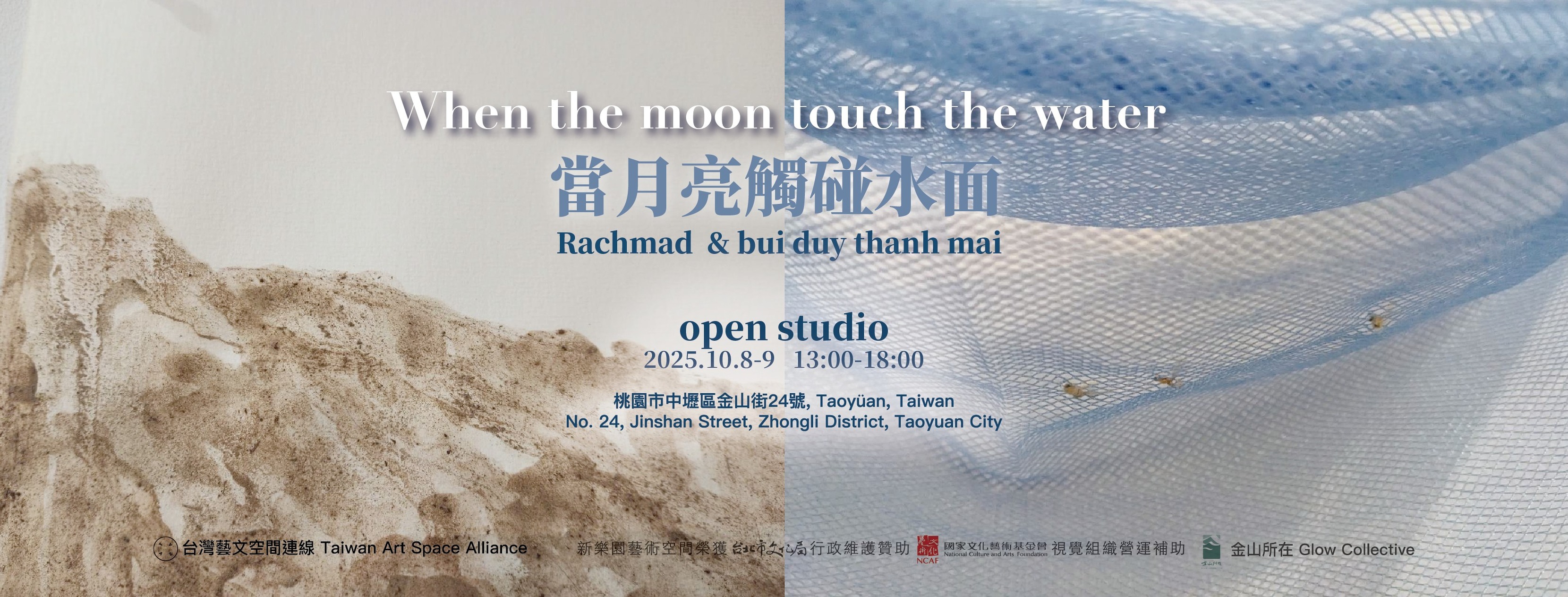
The conversation between Bùi Duy Thanh Mai and the Artist-in-Residence Vietnam Network (AiRViNe) took place following her residency at SLY Art Space (Taoyuan, Taiwan), within the framework of a collaborative program between the Taiwan Arts Space Alliance (TASA), AiRViNe, and Heritage Art Space. From September to October 2025, Thanh Mai lived and worked at SLY Art Space. The residency concluded with the open studio When the Moon Touches the Water, held on 8–9 October 2025.
Rather than approaching the residency as a summary of achievements or a report of outcomes, the interview is framed as an open and reflective dialogue. The questions focus on the artist’s lived experience: from initial expectations and working–living conditions to possibilities for connection and exchange, as well as the structural limitations of the artist residency model in a contemporary context.
The conversation also expands to broader questions: what distinguishes a residency from an ordinary temporary accommodation; the role of the host in providing care for artists; and the degree to which a residency program aligns with different stages of artistic practice. Thanh Mai’s reflections do not aim to pass judgment, but instead raise necessary questions about transparency, initiative, and the capacity to create meaningful points of encounter between hosts and resident artists.
Within this dialogical framework, the interview does not merely document a personal experience, but also reflects broader considerations of how residency programs may—or may not—respond to the diverse needs of artists today. This is also the spirit that AiRViNe seeks to cultivate: viewing residency as an ongoing process of dialogue, in which mutual understanding and suitability are as important as tangible outcomes.

Interview
AiRViNe: Is this your first international artist residency? And did the actual experience differ from how you had imagined a residency might be?
Bùi Duy Thanh Mai: This is the first artist residency I’ve participated in, but not my first international exchange program. The exchange programs I joined previously were all quite clearly structured, which created certain expectations—what the program aimed to achieve and what I was expected to do in order to meet those goals.
In contrast, this residency had almost no clearly defined direction from the outset. Because of that, I didn’t carry many expectations with me. Once I arrived, of course there were moments when I thought, “I wish I had this or that,” but looking back, it was precisely the absence of expectations that made the experience more comfortable. I didn’t feel pressured to achieve any specific goal; I was simply there, observing and receiving whatever came my way.
I felt quite free in how I approached this residency. Some other artists were very proactive in asking about the host’s expectations and what the program required of them, and that sometimes seemed to make them more anxious. I didn’t take that approach. I thought that if the host didn’t clearly articulate expectations, perhaps they themselves didn’t have any specific demands in mind.
AiRViNe: Regarding the proposal you submitted before the residency, were you able to realize what you had outlined?
Bùi Duy Thanh Mai: I think I was still able to carry out what I had written in the proposal, even though at the time of writing it I had almost no concrete information about the residency space. If there is one thing I wish for, it would be to have had clearer, more direct information about the center before arriving.
I place a lot of value on direct, first-hand information. In this case, everything was mediated through several layers. I didn’t know who was responsible for the space, what kind of person they were, or how they worked. It wasn’t until I physically arrived, knocked on the door, and stepped into the space that I truly understood: “Ah, this is where I will live and work.”
At the same time, precisely because I wasn’t constrained by a system of expectations or specific instructions, I felt quite at ease. I didn’t have to rely on second-hand descriptions; I could experience everything for myself.
AiRViNe: During the residency, did you receive ongoing support or accompaniment from the host? For example, regular check-ins or discussions?
Bùi Duy Thanh Mai: Not really. There was mainly a shared group chat—if you needed something, you could message there. But there were no regular sharing sessions or scheduled exchanges.
In fact, it was only toward the end of the residency, when an artist from Indonesia came to stay and work alongside me, that I truly felt the meaning of the residency. Both of us said to each other, “Only now do I really understand why we’re here.”
Before that, working alone, I was still doing what I always do. But once there was exchange—sharing lived experiences and working in different contexts—things began to layer and overlap. When you listen to someone else talk about where they come from, and you share what you’re seeing and experiencing, the residency truly becomes something different from simply “renting a house elsewhere to work.”
Even if the host doesn’t actively create spaces for exchange, if there is a community—even a small one—artists can still learn a great deal from one another.
AiRViNe: Did you have opportunities to connect with the local artist community or art scene?
Bùi Duy Thanh Mai: Quite by chance. There happened to be an exhibition taking place at the time, so I met a few other artists and became friends with them. After that, I also took the initiative to visit some other art spaces and communities.
The organizers often asked whether I needed anything or wanted to connect with anyone. But at that point, I didn’t have very specific needs. In the first meeting, I mentioned that I wanted to meet certain people, but then I realized that my needs were actually quite specific—such as meeting and observing the Vietnamese community in Taiwan—and that it was easier for me to take the initiative myself in that regard.

AiRViNe: Overall, how connected did you feel during this residency?
Bùi Duy Thanh Mai: That’s a difficult question. I felt that I did make meaningful connections, but they weren’t actively facilitated by the program. They emerged from chance encounters or from my own initiative.
This leads to a larger question: what distinguishes an artist residency from staying in an Airbnb? A residency cannot simply provide accommodation. What matters is that the host understands why they are running a residency program and communicates that clearly from the beginning.
If a host were to say openly, “We can only provide information; we don’t have the capacity for deep accompaniment,” that would be completely fine. The issue isn’t how much or how little support is offered, but rather transparency.
AiRViNe: What about the Open Studio?
Bùi Duy Thanh Mai: If the goal was to attract a large audience, then clearly it wasn’t suitable. Many of my friends couldn’t attend because the time frame was too short. The decision to open for only two days wasn’t mine; it resulted from the space’s schedule not being clearly communicated from the beginning.
During the preparation process, information between the parties was quite vague: access to the space, key handover, specific schedules—all of these were not clearly confirmed in writing. That put everyone in a tense and reactive position.
Nevertheless, I truly appreciate those who came, those who offered support and care, and the encounters that did take place. For me, an Open Studio isn’t about the number of visitors, but about the quality of the encounters.
AiRViNe: After this residency, what do you feel you gained most clearly?
Bùi Duy Thanh Mai:I have a clearer understanding of what I want and what kind of experience suits me. These realizations don’t always come from a “perfect” program, but from going through things myself and encountering friction along the way.
This residency gave me an opportunity to rethink the role of artist residencies and the notion of care—not only care for artworks, but for the artist’s entire life and practice. For me, that is a very important value.
Overview:
Looking back on the entire experience, Bùi Duy Thanh Mai does not negate the space or the residency model she participated in. On the contrary, she suggests that it could still be the same space, but with different forms of human interaction and different conditions of exchange, she might consider returning in another context.
Mai also emphasizes that the suitability of a residency program is never absolute. For local artists—for example, artists based in Taiwan—this space could be a suitable option, as they already have networks, cultural context, and a stronger capacity for self-connection. What matters is not whether a residency is “good” or “not good enough,” but whether it aligns with the needs and the stage of practice of each individual artist.
From this perspective, Mai proposes a core principle for residency programs: initiative and transparency on the part of the host. When a space can clearly present itself—what it can and cannot offer, and how it envisions the role of the resident artist—this clarity helps attract the most suitable residents. Residency, in this sense, is not a one-size-fits-all model, but a point of encounter built on mutual understanding.
Interviewer: Trần Thảo Miên, Nguyễn Tú Hằng
Editor: Nguyễn Tú Hằng
About the artist: Bùi Duy Thanh Mai is an independent interdisciplinary researcher in social sciences and humanities. Mai graduated with degrees in Philosophy, Education and Asian studies in the US. She has multiple years of experience in consulting, designing and implementing solutions aimed at changing school curricula and social activity groups across the country. Mai was involved in the independent textbook project Cánh Buồm and is a member of the Philosophy with Children and Youth Network for Asia and the Pacific. In 2020, she initiated bóc-hành collective (unlayering-the-onion), a space in which members together explore underlying social issues and especially the gender aspects, with topics touching on responses to gender-based violence and concerns of modern-day office workers.
In 2024, after releasing the publication “Tan ca thôi, những niềm riêng tiếp nối” in February in the role of the editor-in-chief, Bùi Duy Thanh Mai focused on the theme of the kitchen. She wrote “Hiện tượng học ‘căn bếp’” (The ‘kitchen’ phenomenology) (Văn Nghệ Newspaper), “Bếp, chuyện nhỏ mà không nhỏ” (The kitchen: A small matter, yet not small) (Văn hóa quân sự Special), and coordinated the workshop series “Bếp ở đâu trong mỗi người?” (Where is the kitchen in each of us?) as part of the children’s book exhibition “Bế bế bồng bồng” at The Outpost Art Organisation. She was also a guest speaker in the talk event “Nấu nướng và Ngợi khen: Nhìn về giới từ căn bếp” (Cooking and Praise: A gender perspective focusing on the kitchen) (VGEM), and in the TV programme Cuộc sống thành thị (Urban life) (Hanoi Television) in the episode “Căn bếp đô thị: Nơi phản chiếu những thách thức của đời sống hiện đại” (Urban kitchen: A reflection of the challenges of modern life).
Bùi Duy Thanh Mai participated in three open studio events in “mấy mảnh vải mấy đường chỉ mấy nơi the queer w(e)aves” in collaboration with Queer Forever! and bà-bầu AIR. Mai was also a speaker at the academic seminar “Nữ tính vĩnh hằng và sự chất vấn từ cảm quan giới” (Eternal Femininity and the Questioning from Gender Perception) (Vietnam Institute of Literature). She was one of the 16 feminist creators selected to participate in the forum “Reclaiming narratives: feminist artivism in East, South, and Southeast Asia” in Taipei in June 2024. In early 2025, Mai displayed her work “We never hurt alone” at the duo exhibition “I Carry Your Love on My Back” in New Zealand.